Last Updated on 4 months ago by The Executive post
Most people think passive income means owning a rental flat or buying dividend stocks. Fair assumption but both take serious money upfront, and most of us don’t have that sitting around. Here’s what’s actually changed, it’s never been more accessible to build passive income with AI tools, and the entry cost is often less than a monthly streaming subscription.
A salaried professional in Bengaluru, a freelancer in Manchester, or a side-hustler in Chicago can now set up income streams that run without checking in every hour. Not a fantasy. Not a get-rich-quick pitch. Real, repeatable systems that quietly growing numbers of working people are building around their existing jobs and lives without quitting anything, without a business degree, and without a startup budget.
Table of Contents
AI Tools for Passive Income
Passive income means money coming in without you actively working for it at that moment. The “passive” part does not mean zero effort — it means the work you do once keeps paying you later.
AI tools change the equation because they compress that upfront work dramatically.
Here is the idea in plain terms. You use an AI writing assistant to help create a digital product — an e-book, a template pack, a course outline. You spend a weekend building it. You list it on a platform that sells it automatically. Every sale after that is money earned while you are doing something else entirely.
Or you use AI to build a niche content website. The AI helps you research topics, draft articles, and structure pages. You publish for a few weeks. The site ranks on Google. Advertisers pay you monthly through ad networks like Ezoic or Mediavine. That revenue runs on its own.
The same logic applies to:
- AI-generated stock images sold on Shutterstock or Adobe Stock
- AI-scripted YouTube videos using text-to-video tools like Pictory
- Automated newsletters managed with AI writing and scheduling tools
- Prompt packs sold on marketplaces like PromptBase
AI handles the heavy lifting of creation; you focus on setup and distribution. This works whether you are in India earning in dollars through Gumroad, or in the UK monetizing a niche blog. The tools are globally accessible. The income, once built, does not care what time zone you are in.
How to Make Money With AI in 2026
Let’s be honest, not every AI tool is worth your time. Here are the strategies generating real income right now, with numbers to help you decide which fits you best.
| Strategy | AI Tool Used | Setup Time | Monthly Income Range | Best For |
| Niche content blog | Claude / ChatGPT + Surfer SEO | 4–8 weeks | $200–$2,000 | Writers, researchers |
| Digital products (e-books, templates) | ChatGPT + Canva AI | 1–2 weekends | $100–$1,500 | Creators, professionals |
| AI stock images | Midjourney / DALL-E | 1 week | $50–$500 | Visual creatives |
| AI YouTube channel | Pictory / Synthesia | 3–6 weeks | $300–$3,000 | Video-comfortable creators |
| Prompt packs | ChatGPT (for crafting) | 2–3 days | $50–$400 | Technical users |
Niche Blogs With AI Content
This remains the most scalable option in 2026. Pick a narrow topic — “personal finance for NRIs” or “home workouts for desk workers in the UK.” Use an AI writing assistant to draft 30–50 focused articles. Publish on a self-hosted WordPress site. Once Google indexes your content and it ranks, ad revenue flows monthly. If you are starting a personal finance blog, it also helps to know exactly how to prompt your AI correctly — our guide on ChatGPT for Personal Finance shows you the exact prompts that get useful, publish-ready output rather than generic filler.
The critical part: do not publish raw AI output. AI tools generate words fast — but money comes from useful, specific content that solves a real problem. Add your own expertise, local examples, and genuine opinions. That is what separates ranked content from ignored content.
Digital Products
This is the fastest path to your first passive dollar. Build a financial tracker in Notion. Use ChatGPT to write a 30-page e-book on something you know well. Create a resume template pack. List it on Gumroad, Etsy, or Payhip. Every sale is automatic — no shipping, no warehouse, minimal customer service.
Best AI Tools to Earn Money Online
Most people waste weeks testing every shiny tool they see. Save yourself the time. Here is what actually matters when choosing an AI tools for income generation.
For writing-based income: ChatGPT and Claude are the most versatile. Both handle long-form content, product descriptions, e-books, and email sequences. Claude tends to produce more nuanced, structured writing. ChatGPT has a larger ecosystem of plugins and integrations. Either works — pick one and get good at it.
For visual income: Midjourney produces the highest quality AI images for selling on stock platforms. DALL-E is built into ChatGPT and easier for beginners. If you plan to sell digital art or design assets, Midjourney is worth the $10/month subscription.
For video income: Pictory converts written scripts into videos automatically using stock footage. Synthesia goes further — it creates a realistic AI presenter reading your script. Both are used by creators running faceless YouTube channels generating ad revenue on autopilot.
For SEO and blog income: Pair your writing AI with a keyword tool. Surfer SEO or LowFruits help you find topics with real search demand but low competition. Without this, your AI-written articles may be well-written but invisible on Google.
One honest warning: no tool replaces judgment. The people earning consistently from these platforms are not the ones using the most tools — they are the ones who understand their audience and edit everything their AI produces with a critical eye.
Digital Products With AI
If you are starting from zero and want results within 30 days, digital products are your best entry point. Here is the exact process.
Step 1 — Choose your product type. The simplest options are e-books, spreadsheet templates, Notion dashboards, resume kits, or prompt packs. Pick something connected to your existing knowledge. A finance professional could build a personal budget tracker. An HR manager could create an interview question bank. You already have the expertise, AI helps you package it faster.
Step 2 — Build it using AI assistance. Open ChatGPT or Claude. Give it a detailed brief: your topic, your target reader, the problem you’re solving, and the format you want. It will give you a strong draft. Your job is to edit, add your own examples, and make it actually useful not just technically complete.
Step 3 — Set up your storefront. Gumroad is free to start and takes a small percentage per sale. Payhip offers similar features. Etsy works well for templates and design asset it comes with built-in traffic. Upload your product, write a clear description that explains the benefit (not just the features), and set a price between ₹499–₹1,999 or $7–$25 depending on depth.
Step 4 — Drive your first traffic. Share it in three communities where your target buyer already hangs out a relevant subreddit, a LinkedIn post, a Facebook group. Be genuinely helpful. Don’t spam. Let the product speak.
Realistic numbers: your first sale may take 2–3 weeks. By month three, with consistent effort, $100–$300/month from a single digital product is achievable for most people who follow through.
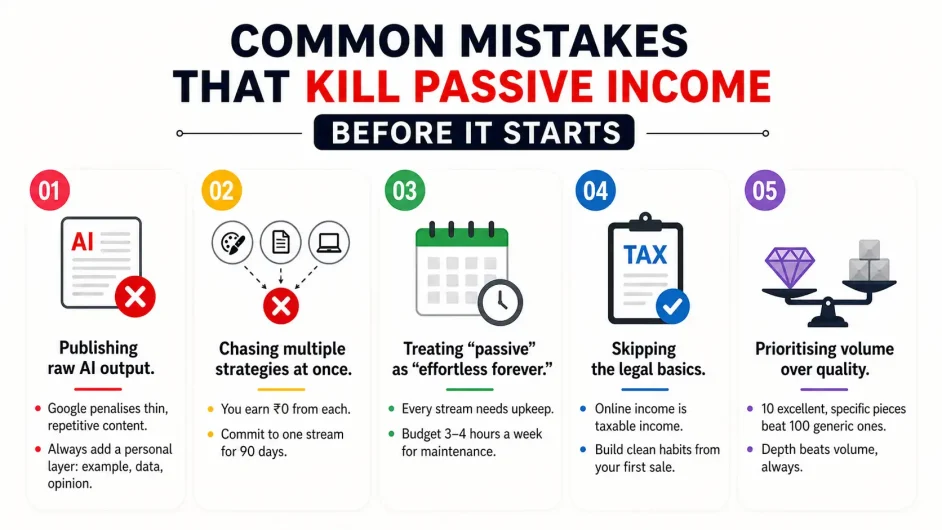
Common Mistakes That Kill Passive Income Before It Starts
Mistake 1: Publishing raw AI output. Google penalises thin, repetitive content. Readers feel it immediately. Unedited AI writing is generic by nature — it says something about everything and nothing with depth. Always add a personal layer: a real example, a local data point, a genuine opinion.
Mistake 2: Chasing multiple strategies at once. You see someone earning from AI art, someone from prompt packs, someone from a blog. You try all three simultaneously. You earn ₹0 from each. Focus is the actual strategy. Commit to one stream for 90 days before adding another.
Mistake 3: Treating “passive” as “effortless forever.” Every passive income stream needs upkeep. Blogs need new content. Digital products need occasional updates. YouTube channels need fresh topics. Budget 3–4 hours a week for maintenance once you’re up and running.
Mistake 4: Skipping the legal basics. Whether you are in India, the UK, or the US — online income is taxable income. Don’t ignore it thinking it’s too small to matter. Build clean habits from your first sale.
Mistake 5: Prioritising volume over quality. Ten excellent, specific blog posts will outrank a hundred hollow ones every time. Ten focused, well-edited digital products will outsell a hundred generic ones. Depth beats volume, always.
Conclusion
Three things matter most here. First, AI tools are a lever, not a magic wand — they work when you apply real knowledge and judgment to their output. Second, passive income requires active setup — the passive part arrives after consistent early effort. Third, starting small and specific beats waiting to start big — a digital product listed on Gumroad today beats a perfect business plan sitting in your notes.
Your one action today: open ChatGPT or Claude and type — “Give me 10 niche digital product ideas based on my background in [your field].” That single prompt is your starting point. Take it.
Frequently Asked Questions (FAQ)
Can I build passive income with AI tools in 2026 without technical skills?
Yes — most AI tools today require no coding. Platforms like Gumroad, Canva AI, and ChatGPT are built for non-technical users. The learning curve is measured in hours, not months. You need curiosity and consistency more than any technical expertise.
How much money can I realistically make from AI Tools passive income?
It varies by niche, effort, and consistency. Beginners typically earn $50–$200 in their first two months. With six to twelve months of consistent effort, many creators reach $500–$2,000 per month from a single stream. Treat higher figures as exceptions, not the baseline expectation.
Which AI tools is best for passive income in 2026?
There is no single best tool — it depends on your strategy. ChatGPT and Claude are the most versatile for writing-based income. Midjourney leads for AI art. Pictory and Synthesia are the top choices for AI video channels. Start with the tool that matches your chosen strategy, not whichever one has the most hype this week.
Is passive income from AI tools taxable in India?
Yes. Income from digital products, ad revenue, and online platform payouts is taxable in India. It falls under “Income from Other Sources” or “Profits and Gains from Business or Profession” depending on how you operate. File it in your ITR and consult a CA if your annual online earnings exceed ₹50,000.
How long before I see my first passive income from AI tools?
Expect 4–10 weeks before your first sale or ad payment, depending on the strategy. Blog ad income takes the longest — typically three to six months for meaningful traffic. Digital product sales can happen within days of listing if you market actively. Set a six-month horizon and measure progress monthly, not daily.

Financial & Data Analytics Specialist | Investigations & Research | NCFM Certified | Editor | Investment Analyst | Finance Blogger | Writer | Over 15+ years of experience, turning complex money matters into clear insights. Through my writing, I help readers navigate wealth, markets, and financial trends with confidence.