Last Updated on 4 months ago by The Executive post
Most Indians own gold but most of them are doing it the hard way. Storing jewellery at home, paying bank locker fees, worrying about purity every time they buy. Sound familiar?
Here’s a number worth pausing on: India consumes roughly 700–800 tonnes of gold every year, making it one of the biggest gold markets in the world. Yet a huge chunk of that sits in informal, unregulated forms often bought from Jewelers with no standardization at all.
That’s finally changing. Electronic Gold Receipts India or EGRs are a brand new SEBI-regulated instrument launched on the National Stock Exchange (NSE) in May 2026. They let you own real, physical gold digitally, stored in accredited vaults, and traded like a stock straight from your demat account.
Table of Contents
What Are Electronic Gold Receipts (EGR) and How Does This New Gold
An Electronic Gold Receipt (EGR) is a digital certificate proving you own a specific quantity of physical gold. That gold isn’t sitting in some abstract fund. It’s a real bar, in a SEBI-accredited vault, with your demat account number attached to it.
Here’s how the full process works, end to end:
- A refiner, institution, or large investor deposits physical gold with a SEBI-registered vault manager.
- That gold is converted into EGR units and credited to a demat account.
- Those units are listed and traded on the NSE — just like shares of Infosys or Tata Steel.
- You, as a retail investor, can buy those units during normal market hours.
- Whenever you want the physical gold back, you submit a redemption request and take delivery.
Each EGR maps to a standardised quantity — typically 1 gram or higher. The gold must conform to the Good Delivery Standard of the London Bullion Market Association (LBMA) or the Bureau of Indian Standards (BIS), so purity is guaranteed at source, not something you have to verify at a jeweller’s shop.
What makes EGRs genuinely different from previous digital gold options in India is regulation. Apps that sold “digital gold” earlier had no SEBI oversight and no exchange mechanism behind them. Your gold might have been stored somewhere but if the platform ran into trouble, so did your investment. EGRs operate within the full SEBI framework, with depositories, vault managers, and exchange settlement all governed by clear rules.
For working professionals already using Zerodha, Groww, or HDFC Securities, there’s no new account to open. It’s the same demat account, the same interface just a new, safer way to hold gold.
India’s SEBI data has long shown that formal investment participation remains low among the general public. For a sharper look at why that gap persists and what it costs ordinary households, this piece on why only 1 in 10 Indian families invest puts the numbers in striking context.
EGR vs Gold ETF vs Physical Gold: Which Digital Gold Option in India Makes More Sense?
| Feature | EGR | Gold ETF | Physical Gold |
| Backed by physical gold | Yes (direct) | Yes (via fund) | Yes |
| Purity guaranteed | Yes (LBMA/BIS) | Yes (via fund) | Varies by jeweller |
| Can convert to physical | Yes | Generally no (retail) | N/A |
| SEBI regulated | Yes | Yes | No |
| Traded on exchange | Yes (NSE) | Yes | No |
| Storage cost | Vault fees | Fund expense ratio | Locker fees |
| Minimum investment | 1 gram | 1 unit (₹500–600) | Varies |
The key difference between EGRs and gold ETFs comes down to one thing: what you actually own. A gold ETF is a fund, you own units of a fund that holds gold on your behalf. An EGR is a receipt, you own the actual gold sitting in a specific vault. That distinction matters the moment you want physical delivery.
With gold ETFs, retail investors generally can’t redeem for a physical bar. It’s not designed that way. With EGRs, physical conversion is a core feature built in from day one. If you want your 100 grams back as an actual bar, you can request it.
That said, gold ETFs have one clear edge right now: an 18 year track record. They’ve been running in India since 2007, are highly liquid, and are well understood by most brokers and advisors. EGRs, launched in May 2026, are genuinely new and market depth will grow over time and bid-ask spreads may initially be wider.
Sovereign Gold Bonds (SGBs) round out the comparison. Government-issued, offering 2.5% annual interest, but with an 8-year maturity and no physical conversion option. For long-term, passive holders, SGBs are compelling. For investors who want flexibility and physical optionality, EGRs win on structure.
If you want to understand the full mechanics of how gold ETFs work in India step by step — alongside this EGR comparison, the deep-dive guide on how to invest in Gold ETFs in India is the most practical companion read.
How to Start Investing in EGRs: A Practical Step-by-Step Guide to Safe Gold Trading on NSE
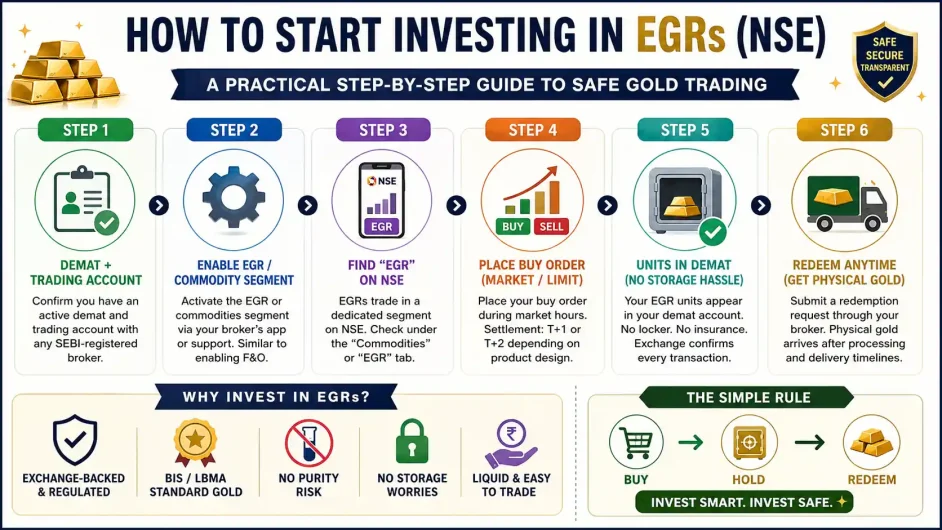
It’s genuinely straightforward if you’re already active in India’s equity markets. Here’s the exact process in 2026:
Step 1 — Confirm you have an active demat and trading account. Any SEBI-registered broker works — Zerodha, Angel One, ICICI Direct, HDFC Securities, Groww. No separate account is required for EGRs.
Step 2 — Enable the EGR or commodities segment with your broker. Some platforms require you to activate this separately, similar to enabling F&O (futures and options) trading. A quick request through your broker’s app or support team handles it.
Step 3 — Find the EGR segment on NSE through your broker’s platform. EGRs trade in a dedicated segment on the NSE. As rollout matures through 2026, most major broker apps will surface these under a “Commodities” or “EGR” tab.
Step 4 — Place your buy order during market hours. Standard market or limit orders apply, just as with equities. Settlement follows standard exchange mechanisms — T+1 or T+2 depending on the product design.
Step 5 — Your EGR units appear in your demat account. No locker needed. No insurance to arrange separately. No wondering whether your jeweller passed off 18 Carat metal as 22. The vault holds BIS/LBMA-standard gold, and the exchange confirms every transaction.
Step 6 — Request physical delivery whenever you’re ready. Submit a redemption request through your broker. Physical gold arrives after processing and delivery timelines set by the vault manager.
A few practical numbers: at launch, NSE demonstrated dematerialisation of a 1,000-gram gold bar — roughly ₹85–90 lakh at current prices into EGR units. That’s institutional scale, but the instrument is designed for retail investors too. At 1 gram minimum with gold around ₹8,500–9,000 per gram, entry is accessible for most salaried professionals across India.
Building a gold position is one part of a healthy financial plan. If you’re still working on the foundational layer knowing where your monthly income actually goes the guide on best free apps to track expenses in India is a natural next step before committing any new capital.
Why EGRs Matter for India and Indian Investors: Physical Gold, Digital Gold, and the NSE Moment
India has a complicated relationship with gold. It’s cultural, emotional, and financial all at once. Weddings, festivals, inheritance – gold runs through all of it. But that deep attachment has also kept hundreds of billions of rupees locked in informal, inefficient, and sometimes outright unsafe formats.
Here’s the real problem with how most Indians hold gold today.
Physical gold : Jewellery, coins, and bars comes with significant friction. Making charges on jewellery range from 5% to 25% of the gold value. Bank locker fees run ₹2,000–5,000 per year. Purity is inconsistent across jewellers, and when you sell, you rarely recover the full market price. The buy-sell spread alone is often 5–10% which means physical gold has to appreciate substantially before you actually profit.
Unregulated digital gold : The kind sold through popular apps and e-wallets solved the storage problem but created a regulatory vacuum. SEBI had raised concerns about several such platforms, and investors had no formal recourse if a platform mismanaged gold reserves or shut down. For millions of Indians who moved to digital gold thinking it was the “safer” option, the reality was murkier than expected.
EGRs close that gap completely. They are SEBI-regulated, exchange-traded on the NSE, vault-backed with standardized purity, and redeemable for physical gold. It’s the first instrument in India that brings all four of those features together in a single product.
The timing is significant too. The NSE recently crossed 12 crore registered investors, a milestone that reflects how far India’s capital market infrastructure has matured. A platform of that depth can now genuinely absorb and sustain a new instrument like EGRs. For context on what that milestone signals for India’s retail investing future, this piece on NSE’s investor base hitting 12 crore is worth reading.
There’s also a macroeconomic angle that’s easy to miss. India imports 700–800 tonnes of gold annually , a major driver of the current account deficit. EGRs create a pathway for domestically recycled gold to re-enter the formal economy as a tradeable, regulated asset. If even 10–15% of informal gold demand shifts toward EGRs over the next decade, the effect on India’s import bill could be material.
For Indian investors, the most practical takeaway is EGRs give you a complete, regulated loop. Buy digitally, hold in your demat account, trade in real time on the NSE, and redeem for a physical bar when you want.
Conclusion
Gold investing in India just got a genuine structural upgrade. Here are the three things worth remembering:
Electronic Gold Receipts are SEBI-regulated, exchange-traded on NSE, and directly backed by physical gold in accredited vaults and the most transparent gold investment structure India has ever offered retail investors.
Unlike gold ETFs, EGRs give you the option to redeem for actual physical gold. Unlike unregulated digital gold, they sit inside a full regulatory framework with real investor protections.
The minimum is 1 gram, entry is through your existing demat account, and EGRs were built specifically with India’s retail investor in mind not just large institutions.
Frequently Asked Questions (FAQ)
What are Electronic Gold Receipts India and how are they different from Digital Gold apps?
Electronic Gold Receipts (EGRs) are SEBI-regulated securities traded on the NSE, representing direct ownership of physical gold in accredited vaults. Digital Gold sold through apps like PhonePe or Paytm is largely unregulated and not exchange-traded making EGRs significantly safer and more transparent for Indian investors.
How do I buy Electronic Gold Receipts in India?
You need an active demat and trading account with any SEBI-registered broker. Once your broker activates the EGR segment, you can place orders during NSE market hours just as you would for shares. The EGR units are credited to your demat account after settlement.
Is investing in EGRs safe, what happens if the vault manager shuts down?
EGRs are structured so that gold is held through regulated depositories under SEBI oversight not directly on the vault manager’s balance sheet. The design means your gold remains yours even if a vault manager faces operational difficulties, similar to how your shares remain yours if a depository participant closes.
Can NRIs invest in Electronic Gold Receipts?
NRI eligibility under FEMA guidelines is still being clarified as the instrument matures through 2026. NRIs with NRE or NRO demat accounts should check directly with their broker for the latest status.
How do EGRs compare to Sovereign Gold Bonds for long-term investors?
Sovereign Gold Bonds offer a 2.5% annual interest rate and government backing, but carry an 8-year tenure and no physical gold conversion. EGRs have no lock-in, no interest income, but offer full physical redemption and real-time tradability on the NSE. Both serve different goals and can work together in a well-balanced portfolio.

Financial & Data Analytics Specialist | Investigations & Research | NCFM Certified | Editor | Investment Analyst | Finance Blogger | Writer | Over 15+ years of experience, turning complex money matters into clear insights. Through my writing, I help readers navigate wealth, markets, and financial trends with confidence.